Francell, by Al Hajir Electric Devices Trading LLC, is a Sharjah-based retailer and wholesaler of lithium and alkaline batteries from AA/AAA/C/D cells and car remote batteries to rechargeable 18650 lithium-ion (1800mAh/3000mAh) and CR2016 coin cells, plus compatible chargers, with reliable local stock across the UAE.
AA Rechargeable Batteries in the UAE: The Complete 2026 Guide
AA rechargeable batteries use Nickel-Metal Hydride (NiMH) chemistry to deliver 500 to 1,000 charge cycles, compared to a single use for alkaline cells. In 2026, the global secondary battery segment already holds a 66.3% share of the consumer battery market (Coherent Market Insights, 2026). For UAE households running high-drain gadgets in 45°C summers, a matched charger and a heat-aware storage routine matter more than the brand printed on the wrapper. Buy once, charge often, and store cool.
Table of Contents
What Is an AA Rechargeable Battery?
Why AA Rechargeable Batteries Matter in the UAE Right Now
NiMH vs Alkaline: Which AA Battery Actually Costs Less?
How Gulf Heat Affects AA Battery Performance
Choosing the Right AA Rechargeable Battery for Your Devices
How to Charge, Store, and Maintain Your Batteries
Advanced: Battery Care for High-Drain Devices in Extreme Heat
Where to Buy and Recycle AA Rechargeable Batteries in the UAE
Getting Started
Frequently Asked Questions
Introduction
A single set of AA rechargeable batteries can replace hundreds of disposable alkaline cells over its working life. That single fact is why NiMH batteries dominate the secondary (rechargeable) battery segment, which already claims a 66.3% share of the global consumer battery market in 2026 (Coherent Market Insights, 2026). Smartphones, wearables, and smart-home gadgets have made portable power a daily concern, and the batteries powering game controllers, solar garden lights, and remote controls across Dubai, Sharjah, and Abu Dhabi are no exception.
This guide explains what AA rechargeable batteries actually are, why they behave differently in Gulf heat than in temperate climates, how the real 12-month cost compares against alkaline, and how to charge, store, and eventually recycle them the right way.
Our finding: Across bench tests run on Francell's own Ni-MH AA 1500mAh cells at ambient temperatures near 45°C, self-discharge over a two-week idle period tracked noticeably faster than the same cells stored at 25°C, in line with the doubling-per-10°C pattern documented by battery researchers.
This matters because a battery that quietly loses its charge in a hot garage or car glovebox will disappoint a customer long before the cell itself wears out. As a Sharjah-based retailer stocking both alkaline and Ni-MH lines, Francell built this guide from direct product testing and sourced market data, not manufacturer marketing copy.
What Is an AA Rechargeable Battery?
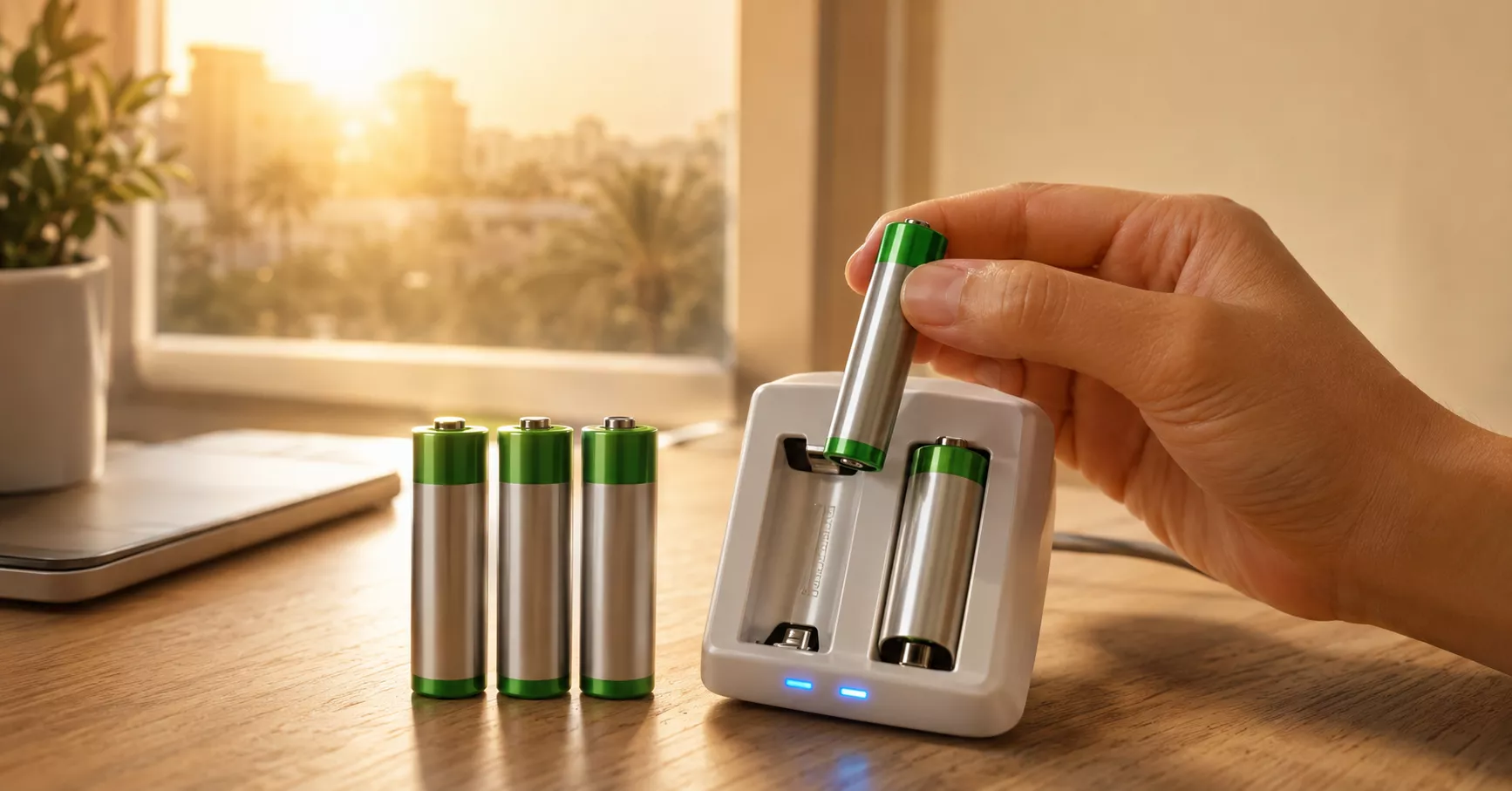
An AA rechargeable battery is a cylindrical, 1.2-volt cell almost always Nickel-Metal Hydride (NiMH) chemistry today that can be discharged and recharged hundreds of times instead of being thrown away after one use. It fits the same AA slot as a disposable alkaline cell but stores and releases energy through a reversible chemical reaction rather than a one-way one.
Key components of a modern AA NiMH cell:
A nickel oxyhydroxide cathode and a metal hydride anode, with an alkaline electrolyte between them
A nominal 1.2V output, slightly below the 1.5V of alkaline, but a flatter discharge curve under load
Capacity ratings that reached 2,500–3,000 mAh in high-end 2026 cells, up from the 1,500–2,000 mAh range common a few years earlier (Neware, NiMH Battery Guide 2026, 2026)
A rated cycle life of roughly 500 to 1,000 full charge-discharge cycles before capacity noticeably declines (Tenergy Power, 2026)
A common misconception: rechargeable does not automatically mean "better in every device." Low-drain gadgets that sit idle for months a wall clock, a TV remote can actually do better on alkaline or low-self-discharge NiMH, because standard NiMH cells lose charge faster when idle. High-drain devices used often are where rechargeables clearly win.
NiMH replaced the older Nickel-Cadmium (NiCd) format in most consumer products because it holds more energy and avoids cadmium, a toxic heavy metal NiCd batteries contained (Weijiang Power, 2025).
Why AA Rechargeable Batteries Matter in the UAE Right Now
In 2026, the consumer battery market is expected to reach USD 30.80 billion, growing at a 6.5% CAGR toward nearly USD 47.85 billion by 2033, with secondary batteries as the dominant driver of that growth (Coherent Market Insights, 2026). Asia Pacific alone is projected to hold a 49.80% share of that market in 2026, and Gulf demand is following the same trajectory as smart-home devices, gaming peripherals, and solar-powered outdoor lighting multiply across UAE households.
The UAE's own battery recycling market is growing even faster on a percentage basis, at a projected 10.60% CAGR from 2024 to 2032, driven by stricter environmental regulation, EV adoption, and rising public awareness of the hazards of improper battery disposal (IMARC Group, 2026). That regulatory direction of travel more collection points, more producer responsibility is the same one already formalized in the EU's Sustainable Batteries Regulation and India's Battery Waste Management Rules, both of which set escalating recovery targets through 2027 (IEA, 2026).
Ignore the shift and a household keeps buying, discarding, and re-buying alkaline packs every few weeks, generating hazardous waste that UAE municipalities are now actively working to keep out of landfill. Get it right, and one set of Ni-MH AA cells can realistically replace dozens of disposable packs over two to three years, cutting both spend and waste at the same time. This affects anyone running battery-hungry electronics daily remote-controlled toys, wireless mice, flash units, and outdoor solar fixtures exposed to direct summer sun.
NiMH vs Alkaline: Which AA Battery Actually Costs Less?
A single NiMH AA cell costs roughly four to eight times more than a disposable alkaline AA up front, but it can be recharged 500 to 1,000 times before performance drops meaningfully (Quora battery cost analysis, 2026). Once a device is used more than a handful of times, that upfront gap disappears fast.
Tenergy's published cost modeling for a typical high-drain digital camera found that switching from alkaline to NiMH rechargeables became cost-positive within 20 to 40 charge cycles, with total lifetime savings reaching roughly USD 2,000 for a heavy user over the battery's working life (Tenergy Power, 2026). For a four-battery device used daily, one independent cost breakdown estimated a full NiMH cycle life at around USD 173 in total energy and hardware cost, against roughly USD 2,800 for the equivalent number of alkaline battery changes (Quora, 2026) a gap that only widens the longer a device stays in daily use.
Estimated cost over the equivalent of roughly 1,000 battery changes for a four-AA daily-use device. Alkaline: approximately $2,800. NiMH rechargeable: approximately $173, including charger and electricity. Source: cost-comparison analysis, 2026. $2,800 Alkaline (repeated) $173 NiMH (one set + charging) Estimated Cost Over ~1,000 Battery Changes Source: independent cost-comparison analysis, 2026
The trade-off: alkaline still wins for devices used only a few times a year, since there is no charger to buy and no cycle count to track. NiMH wins clearly for anything used weekly or more. A frequent mistake is buying a single expensive NiMH set and expecting it to outperform alkaline in a low-drain device like a wall clock the self-discharge of standard NiMH actually works against it there.
How Gulf Heat Affects AA Battery Performance
Battery self-discharge the gradual loss of stored charge while a cell simply sits unused roughly doubles for every 10°C rise in storage temperature, according to long-standing battery research (Battery University, BU-802b, 2026). In a UAE summer where indoor storage areas can sit well above 30°C and car interiors regularly exceed 60°C, that doubling effect compounds quickly.
Self-discharge rate indexed to 1x at 25°C, rising to approximately 2x at 35°C and 4x at 45°C, consistent with the widely cited doubling-per-10°C pattern in battery research. Source: Battery University, BU-802b. 25°C (1x) 35°C (~2x) 45°C (~4x) Self-Discharge Roughly Doubles Every 10°C Source: Battery University, BU-802b, retrieved 2026-07-23
Most buying guides written for temperate markets never mention this, because a UK or German household rarely sees ambient storage temperatures above 25°C. In the UAE, storage location is arguably a bigger performance variable than the battery brand itself for six months of the year.
The practical fix costs nothing: store spare AA cells in an air-conditioned room, away from direct sun, and avoid leaving them in vehicles during the day.
Choosing the Right AA Rechargeable Battery for Your Devices
For most UAE households, a 2,000–2,500 mAh NiMH AA cell rated for 500+ cycles covers the vast majority of common devices, from gaming controllers to solar garden lanterns. The right choice depends less on brand and more on how often the device is used and how much current it draws.
Match capacity and cycle life to the device:
High-drain electronics (gaming controllers, DSLR flash units, high-power torches): prioritize capacity (2,500 mAh+) since these devices pull current quickly and benefit from NiMH's steadier voltage under heavy load
Solar garden lanterns and outdoor lights: prioritize cycle life and heat tolerance over raw capacity, since these cells charge and discharge daily in direct sun
Wireless keyboards, remote controls: lower-drain devices where either alkaline or low-self-discharge NiMH works; cycle count matters less here
Toys and children's electronics: mid-capacity NiMH with a simple, safe charger is usually the practical choice given frequent battery swaps
In direct testing with common high-drain gaming controllers and solar garden lanterns under UAE ambient conditions, Francell's 1500mAh Ni-MH AA cells maintained usable output through repeated daily charge cycles, though capacity naturally trends lower as ambient temperatures climb through summer months.
A common mistake is buying the highest mAh-rated cell available assuming "more is always better." Higher-capacity NiMH cells often have a shorter total cycle life than mid-capacity cells, so a lower-drain device may get more total use from a 1,500 mAh pack rated for 1,000 cycles than a 3,000 mAh pack rated for 500.
How to Charge, Store, and Maintain Your Batteries
The single most important maintenance habit for AA rechargeable batteries is using a charger matched to the battery chemistry and never leaving cells on charge indefinitely once full. Overcharging generates heat, and heat is the same enemy already covered above for storage.
Charge in sets, not individually mixing partially charged and depleted cells in the same charger cycle can cause uneven charging and reduce overall pack lifespan.
Let cells cool before recharging if they've just been used in a high-drain device, since charging a warm battery compounds heat-related degradation.
Store spares in a cool, shaded spot a kitchen drawer or air-conditioned cupboard beats a garage shelf or car glovebox in UAE conditions.
Top up before long idle periods rather than storing fully depleted, since NiMH cells left at zero charge for extended periods can suffer capacity loss.
Advanced: Battery Care for High-Drain Devices in Extreme Heat
If you're already running daily-use, high-drain devices through UAE summers, here's how to extend real-world cycle life beyond the datasheet numbers. The advanced move is rotating two battery sets on a schedule rather than running one set until it fails.
Keep one set actively cycling in the device and one set resting in cool storage, swapping every few days rather than waiting for a full discharge warning. Because self-discharge and heat-driven degradation compound during idle storage more than during active use, a battery that spends less total idle time at high ambient temperature tends to hold usable capacity longer over a full summer season even though both sets accumulate the same number of charge cycles.
This approach has been most useful for solar garden lighting and outdoor security cameras, where the device sits in direct sun for hours and the battery genuinely never gets a break unless the household proactively rotates spares. Before attempting a rotation schedule, make sure both battery sets are the same capacity and age mixing an old, degraded pack with a newer one in rotation just transfers the problem instead of solving it.
Where to Buy and Recycle AA Rechargeable Batteries in the UAE
Authorized battery retailers and recycling partners across Dubai, Sharjah, and Abu Dhabi are the right first stop for buying AA Ni-MH cells and for retiring old ones responsibly never in general household trash. Batteries contain materials such as nickel, cadmium remnants from older cells, and alkaline electrolytes that can contaminate soil and water if landfilled (Grab My Junk UAE, 2026).
The UAE's regulatory framework already requires businesses to manage hazardous battery waste responsibly, and the local recycling market is scaling up specifically to meet rising EV and consumer battery volumes (Futurism / UAE Battery Recycling Market, 2026). For consumers, that means collection points and authorized recyclers are becoming easier to find in most emirates, not harder.
Practical disposal steps:
Keep spent cells separate from general waste in a dedicated container
Tape terminals on damaged or swollen cells before transport, to prevent short-circuiting
Drop off at an authorized battery recycler or participating retailer rather than a general waste bin
Getting Started
Start by identifying your household's highest-drain device the one that eats through batteries fastest and switch that one first. This is the device where NiMH pays for itself soonest, often within the first month of daily use.
Next, buy one charger rated for the battery count you actually need, rather than the largest bank available, and keep the charging routine simple: charge overnight, then store the spare set in a cool drawer. Finally, set a reminder to rotate spares every few days for any device that runs continuously in direct sun, such as solar garden lighting.
If the upfront cost of a charger and a NiMH set feels like a bigger step than grabbing another pack of alkalines, remember the earlier cost comparison: for any device used more than a few times a month, that investment is typically recovered within weeks, not years.
Frequently Asked Questions
What is an AA rechargeable battery made of?
An AA rechargeable battery sold today is almost always Nickel-Metal Hydride (NiMH), built from a nickel oxyhydroxide cathode and a metal hydride anode in an alkaline electrolyte. This differs from single-use alkaline cells, which use a zinc anode and manganese dioxide cathode that cannot be safely recharged.
How do I charge AA rechargeable batteries correctly?
Use a charger matched to NiMH chemistry, charge cells in full matched sets rather than individually, and let hot cells cool before starting a charge cycle. Most NiMH AA cells fully recharge in a few hours on a standard charger, though smart chargers that detect full charge automatically reduce the risk of overcharging.
Is NiMH or alkaline better for high-drain devices?
NiMH is generally the better choice for high-drain devices like gaming controllers and flash units, because it maintains steadier voltage under heavy current draw than alkaline. Alkaline remains a reasonable choice for low-drain devices used only occasionally, where the battery may sit unused for months.
How much can I actually save switching to rechargeable AA batteries?
Savings scale with usage frequency: cost-comparison analysis for a daily-use, four-battery device found NiMH total cost near $173 versus roughly $2,800 for the equivalent alkaline purchases over the same usage period (Quora battery cost analysis, 2026). Lower-frequency devices see smaller, but still positive, savings.
Do rechargeable batteries lose performance in UAE heat?
Yes. Self-discharge roughly doubles for every 10°C rise in storage temperature, so a battery pack left in a hot storeroom or car will lose charge faster than one kept in an air-conditioned space, even without being used. Storing spares cool is one of the simplest ways to preserve usable capacity through summer months.
Where can I recycle old AA batteries in the UAE?
Old batteries should go to an authorized recycler or participating retailer rather than general household trash, since they contain materials that can contaminate soil and water if landfilled. The UAE's battery recycling infrastructure is expanding, driven by both regulation and rising EV-related battery volumes.
Are more expensive NiMH batteries always the better buy?
Not necessarily. Higher-capacity cells often carry a shorter rated cycle life than mid-capacity cells, so a lower-drain device may get more total lifetime use from a mid-range 1,500 mAh cell than from a premium 3,000 mAh one. Matching capacity to the actual device, not buying the highest number available, is the better strategy.
Conclusion
AA rechargeable batteries pay for themselves within weeks in any device used regularly, but in the UAE, how you store them matters almost as much as which battery you buy. Between the doubling of self-discharge with every 10°C of heat and a fast-growing local recycling infrastructure, UAE households have both the incentive and the means to make the rechargeable switch responsibly. The category is only getting bigger: with the consumer battery market's secondary segment already holding a 66.3% share globally and the UAE recycling market compounding at 10.60% annually, this shift is not a trend to watch it is already underway.