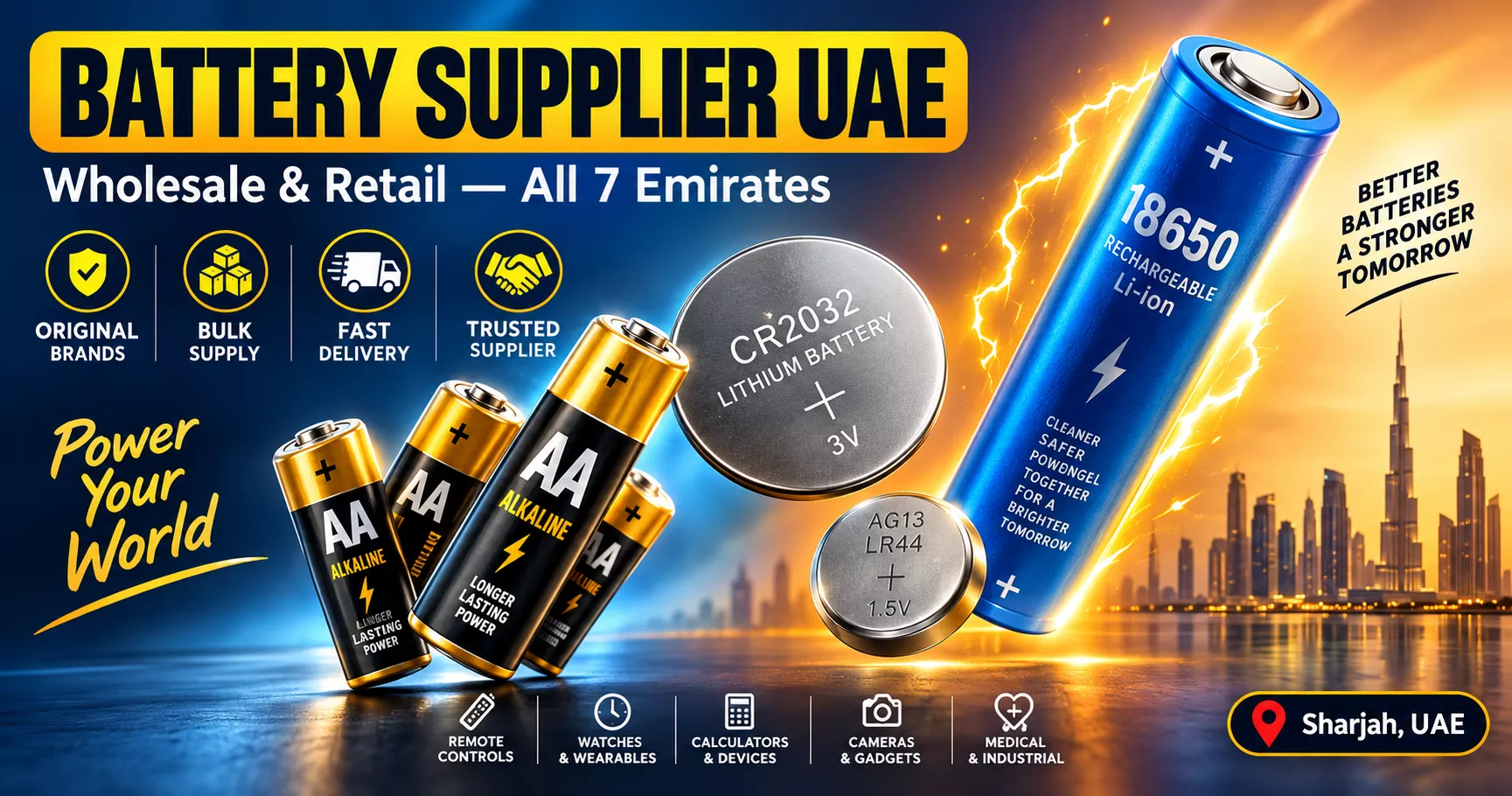
Francell, by Al Hajir Electric Devices Trading LLC, is a Sharjah-based retailer and wholesaler of lithium and alkaline batteries from AA/AAA/C/D cells and car remote batteries to rechargeable 18650 lithium-ion (1800mAh/3000mAh) and CR2016 coin cells, plus compatible chargers, with reliable local stock across the UAE.
How to Buy 14500 Batteries Wholesale in the UAE: 2026 Buyer's Guide
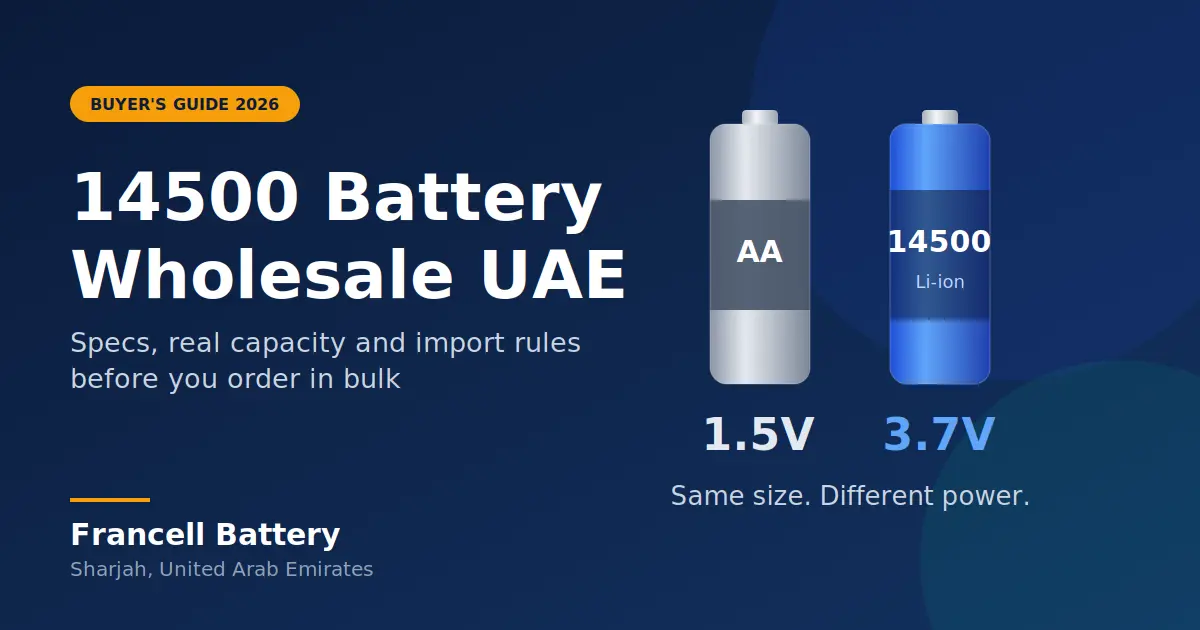
A 14500 battery looks exactly like an AA. It isn't one. In 2026, supplier specifications still list the 14500 at a nominal 3.7V, against 1.5V for an alkaline AA (Longsing Technology, 14500 Battery vs AA). Same body, very different cell.
That gap is where wholesale orders go wrong. Buyers order by size code and get the wrong chemistry, an inflated mAh rating, or a shipment that can't clear customs. Then the stock sits in a warehouse.
This guide walks you through what to check before you buy 14500 cells in bulk in the UAE: specs, chemistry, capacity claims, compliance, and the questions to ask any supplier. It's written by Francell Battery, a Sharjah-based battery wholesaler, so you'll also see what a straight supplier conversation should look like.
Key Takeaways
A 14500 is AA-sized but runs at 3.6-3.7V, more than double an alkaline AA (Battery Junction).
Genuine capacity is roughly 600-1,000mAh; treat 1,300mAh+ claims with suspicion.
Regulated products need a Certificate of Conformity to clear UAE customs.
Test a sample batch before you commit to volume.
What Is a 14500 Battery, and How Is It Different From an AA?
In 2026, retailer specifications still describe the 14500 as a cylindrical lithium-ion cell about 49-50.5mm long and 13.5-14.5mm wide, with a 3.6V or 3.7V nominal output (Battery Junction, 14500 category). It's the rechargeable, lithium-ion cousin of the AA, not a drop-in replacement for it.
If you're sourcing different rechargeable cylindrical cells for your business, you can also review Francell's battery products, which include 14500 and 18650 lithium-ion cells as well as compatible chargers.
The name is a size code. Read "14500" as 14mm diameter by 50mm length, the same footprint as an AA. One reviewer put it neatly: the code covers 3.7V Li-ion or 3.2V LiFePO4 cells, while "AA" is reserved for 1.5V alkaline and 1.2V rechargeable chemistries (Thunderheart Reviews, Queen Battery QB14500 test).
Here's how the three most common AA-sized options compare:
Look at the capacity column and the 14500 seems weak. It isn't. Voltage matters as much as milliamp-hours, and energy is voltage times capacity.
Run the arithmetic on mid-range figures. A 14500 at 800mAh and 3.7V holds about 2.96Wh. An alkaline AA at 2,500mAh and 1.5V holds about 3.75Wh on paper. A NiMH AA at 2,300mAh and 1.2V holds about 2.76Wh. The 14500 sits between them.
Source: Francell calculation using capacity ranges from Longsing Technology, 2026.
Alkaline looks best on paper, but it loses much of that capacity in high-drain devices. That's why a 14500 often runs a bright flashlight harder than an AA can. And that's also why swapping one for the other without checking the device's voltage range is a bad idea.
Batteries built for 1.5V equipment can be damaged by a 3.7V cell (CM Batteries, 14500 vs AA guide). Tell your customers that up front.
If your application needs a different cylindrical lithium-ion format, see Francell's 18650 lithium-ion batteries and other rechargeable battery options.
Which 14500 Chemistry and Format Should You Stock?
Most 14500 cells sold today use a lithium cobalt oxide (ICR) chemistry with a button-top terminal, and listed capacities run from 600mAh up to 1,600mAh (Battery Junction, 14500 category). But three chemistries share the 14500 name, and they don't behave the same.
Suppliers describe NMC and lithium cobalt oxide cells at 3.6-3.7V, and lithium iron phosphate (LiFePO4) cells at 3.2V (CM Batteries, 14500 vs AA guide). That difference decides whether a cell works in a given light or gadget.
Source: CM Batteries and Longsing Technology, 2026.
Two practical choices sit on top of chemistry:
Protected vs unprotected. A protection circuit guards against over-charge and short-circuit, but it can add length. One protected sample listing shows a 1,100mAh rating and a 4.2V full-charge voltage (EEPower forum, 14500 vs AA). Dimensions across the category stretch from about 49.2mm to 50.5mm, so test fit in the host device.
Button-top vs flat-top. Some devices need a raised positive terminal to make contact. A flat-top unprotected cell can be ordered with a protection board and button-top cap in some ranges (Thunderheart Reviews).
Ask your buyers which device they're filling. Then match the cell to it, not the other way round. You can check Francell's current battery product range when comparing available cell formats.
Where Do Businesses Use 14500 Cells?
In 2026, supplier listings pitch the 14500 at a 3.7V output for high-power flashlights, laser pointers and some electronic toys (SCCC Ltd, 3.7V 14500 1300mAh listing). These are devices that want more voltage than a single AA can give.
The flashlight case is the most talked-about. One enthusiast thread reports a light running about 20 minutes on high with a 14500 against roughly an hour with an AA, because the driver pulls more current at the higher voltage (Budget Light Forum, AA vs 14500). That's a single forum anecdote, not lab data. But it shows a real point: brighter isn't the same as longer.
For a wholesale buyer, the takeaway is about returns. If a customer runs a 14500 in a light that was tuned for an AA, they may blame the battery for short runtime. Print voltage and compatible-device guidance on your packaging or product sheet, and you'll cut those complaints.
Published supplier ranges put a genuine 14500 at roughly 600-1,000mAh, with some listings stretching to about 1,200mAh (CM Batteries). A claim of 2,000mAh or more falls outside anything in these sources, and that's a warning sign before you've asked a single question.
In a size this small, physics limits how much lithium-ion chemistry can fit. Inflated numbers are usually printed on the wrap, not measured in a lab. So don't argue with the label. Test the cell.
Use this checklist when you evaluate a 14500 supplier:
Ask for a discharge test report with the test current, cut-off voltage and batch number.
Order a sample pack and test a few cells yourself. Independent reviewers routinely do this with a bench tester and a fixed discharge rate (Thunderheart Reviews).
Weigh a cell. A 14500 typically weighs about 18-20 grams (Longsing Technology). A very light cell with a big mAh number doesn't add up.
Check the cycle-life claim. Suppliers often quote 800-1,000 charge cycles (Eco Lithium Battery). Treat that as a vendor claim until you see test conditions.
Ask for batch traceability, so a bad lot can be traced and replaced.
According to published supplier specifications in 2026, a 14500 delivers 600-1,000mAh at 3.7V and weighs about 18-20 grams. Any listing far outside that range needs an independent test report before you buy in bulk.
A good supplier won't mind these questions. A bad one will get vague.
What Compliance Do UAE Importers Need for Lithium Cells?
In the UAE, regulated products need a Certificate of Conformity, most commonly under the Emirates Conformity Assessment Scheme (ECAS), before they can clear customs and be sold (ATB Legal, UAE product registration and conformity). Conformity oversight now sits with the Ministry of Industry and Advanced Technology (MoIAT), which absorbed the former ESMA.
Two details from the certification process matter for buyers. An ECAS certificate is valid for one year and needs renewal. It also isn't transferable, and it applies only to the product evaluated at the specific facility that made it (SGS, UAE conformity guidelines). So a certificate for one factory's cell doesn't cover another factory's cell.
Lithium cells also carry transport rules. Shippers commonly ask for a UN38.3 test summary and correct dangerous-goods paperwork for air and sea freight. UAE legal commentators flag packaging and transport of lithium batteries as an import challenge in its own right (Al Tamimi & Co, Electric Vehicles in the UAE).
Before you order, ask your supplier for:
The certificate or test report that applies to the exact model and factory
A UN38.3 test summary for the cell
A safety data sheet
Clear labelling with voltage, capacity and chemistry
One caution. Whether a specific loose 14500 cell falls on the regulated products list can depend on how it's classified and sold, and rules change. Confirm the current position with MoIAT, an accredited certification body or your customs broker. This isn't legal advice.
What MOQ, Pricing and Lead Time Should You Ask About?
There's no single market price for 14500 cells, because price moves with chemistry, capacity, protection and order size. So ask for the full picture in writing. A cheap unit price can hide a high landed cost once freight, duty, VAT and testing are added.
Compare suppliers on these points:
Minimum order quantity and whether it applies per model or per order
Price tiers at, say, 500, 1,000 and 5,000 pieces
Ex-stock or on order. Stock held in the UAE ships in days. Direct import from a factory can take weeks and adds customs risk.
Payment terms and whether samples are refundable against a first order
Warranty and returns for dead-on-arrival or off-spec cells
Packaging. Individually wrapped, boxed, or bulk trays
VAT and duties shown separately, so you can compare like with like
The trade-off is simple. Local stock costs a little more per piece but cuts your lead time and your compliance exposure. Direct import can cost less per piece, but you carry the certification and shipping risk.
Francell Battery is operated by Al Hajir Electric Devices Trading LLC and operates from Warehouse 10, Industrial Area 13, Sharjah. We're a retailer and wholesaler of lithium and alkaline batteries: AA, AAA, C and D cells, car remote batteries, 18650 lithium-ion cells in 1,800mAh and 3,000mAh, CR2016 coin cells, and compatible chargers. We hold local stock for customers across the UAE.
You can learn more about the company, its product range and its UAE operations on the About Francell page.
Need 14500 cells? Send us the details and we'll tell you what we can supply and how fast. The more you can share, the quicker the answer:
Only if the device is designed for it. A 14500 delivers about 3.7V against 1.5V for an alkaline AA, so equipment built for 1.5V can be damaged by a 14500 (CM Batteries). Check the device's voltage rating first. If in doubt, don't swap.
Most published ranges sit between 600mAh and 1,000mAh, with some listings reaching about 1,200mAh (CM Batteries) and a few retail pages listing up to 1,600mAh (Battery Junction). Ask for a discharge test report on anything above roughly 1,000mAh.
How many charge cycles does a 14500 last?
Suppliers commonly quote about 800-1,000 charge and discharge cycles for a 14500 (Eco Lithium Battery). That figure depends on discharge current, temperature and charger quality. Ask any supplier for the test conditions behind their number.
Do 14500 batteries need a protection circuit?
Lithium cells benefit from protection against over-charge and short-circuit, and suppliers note that a protection circuit helps guard against temperature-related stress (Longsing Technology). A protected 14500 is typically charged to 4.2V (EEPower forum). Match the choice to the device and charger.
When selecting charging equipment, see Francell's guide to Li-ion battery chargers in the UAE and always verify that the charger supports the chemistry and cell format you are using.
Do UAE importers need a conformity certificate for batteries?
Regulated products need a Certificate of Conformity to clear customs, and an ECAS certificate is valid for one year (SGS, UAE conformity guidelines). Check whether your exact cell is on the regulated list with MoIAT or a customs broker.
Does Francell supply other battery sizes?
Yes. Francell's current battery catalogue includes 14500 and 18650 lithium-ion cells, AA rechargeable batteries, chargers, CR2025, CR2016, AG3 and other battery formats.
Buying 14500 cells wholesale comes down to five checks:
Confirm the chemistry and voltage match the device (3.7V Li-ion or 3.2V LiFePO4).
Treat capacity claims above about 1,000mAh as unproven until tested.
Get the certificate and test report for the exact model and factory.
Compare suppliers on landed cost, not unit price.
Test a sample batch before you place a volume order.
Do that and you'll avoid the three usual failures: wrong voltage, inflated capacity and stranded shipments. Ready to talk numbers? Contact Francell Battery with your specification and quantity, or browse the full Francell battery range.